

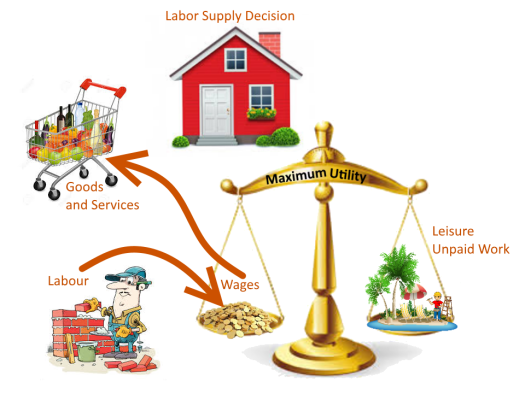
Most people earn an income as compensation for labor. Households must decide:
- Whether to work
- How much to work
- The type of work
These decisions are affected by conditions in the labor market. The budget constraint and opportunity set is determined by:
- Availability of jobs
- Market wage rates
- Skills they possess
The final choice depends on tastes, preferences and expectations about the future
Like with consumer demand, there are lots of trade-offs. Our choices depend on how much we value the alternatives (opportunity cost). The alternatives to working for an income is not working (leisure) or unpaid work (like growing your own food and raising your children).
The Price of Leisure
In Household Demand households had to allocate a limited budget across goods and services. Now households have to choose between goods, services and leisure. Trading off one good for another involves buying more of one and less of another. But buying leisure time simply means allocating less time to work and more towards non-work activities.
For each hour of leisure, I give up one hour of work. So the price (opportunity cost) of leisure equals the wage rate.
Income and substitution effects of wage changes
Leisure is not a normal good… meaning demand does not necessarily increase when wages increase. The issue here is that the opportunity cost of leisure equals the wage rate. So when your wage goes up, your price for leisure also goes up.
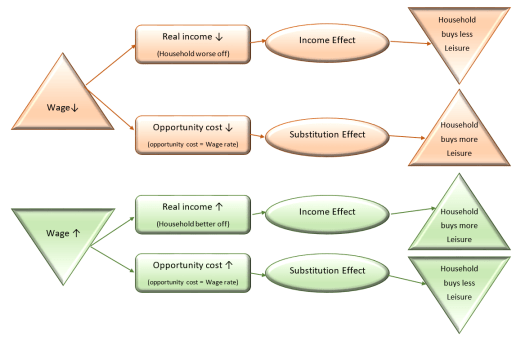
How much leisure a household buys depends on which is the strongest, the income effect or the substitution effect.
References
Karl E. Case, Ray C.Fair, Principles of economics. Seventh Edition, Pearson Prentice Hall, 2004, Chapter 5
 Making it Work
4 Replies to “Household Labor Supply”